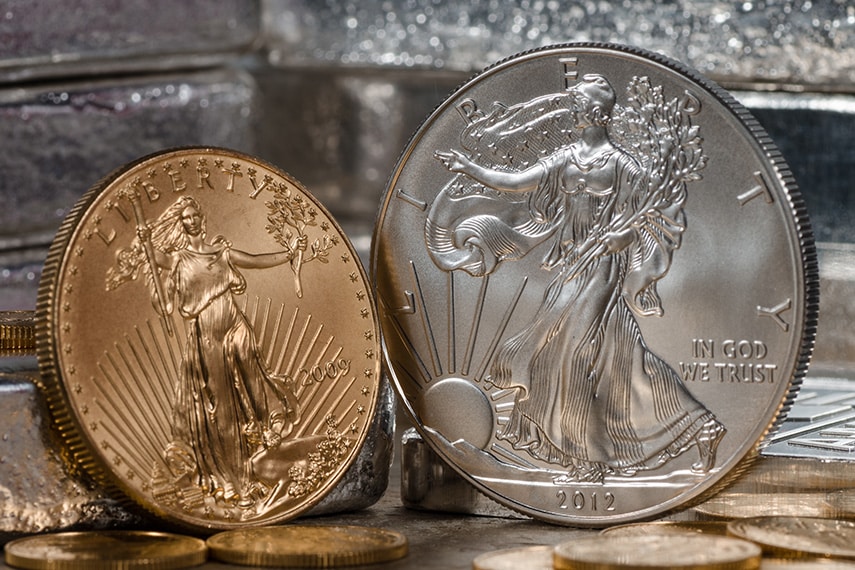
Rising gold prices are a warning signal, indicating increased safe haven buying from individuals and institutions looking for safety amid a potential stock market bubble, geopolitical instability, and recession fears.
Persistent inflation, a national debt that has reached over $40 trillion, and increased central bank gold holdings are signs of declining trust in the US dollar and increased demand for tangible reserve assets.
If you want to help mitigate financial risk and help protect your retirement savings, a tax-free rollover from existing retirement accounts into a gold IRA is one way to help put physical gold to use in helping safeguard your savings.
Prices of goods aren’t just random numbers, they are vital purveyors of information about those goods. Prices can rise and fall as demand increases or decreases, or as supplies of goods decrease or increase.
Changes in perception or attitudes about the future can impact prices too, often just as much as actual physical changes in supply and demand. And all of this information ends up being reflected in prices.
The market dynamics driving precious metals prices today may be telling us something, and it’s something important. Rising gold prices could be sending a warning signal about the health of the global economy, the stability of the US dollar, and the sustainability of record government spending.
If you’ve built up a sizable nest egg for your retirement, listening to what the price of gold is telling us could be vital to helping safeguard your financial future.
Gold Safe Haven Demand
Conventional wisdom has often considered gold to be a countercyclical asset, one that moves in the opposite direction as financial markets. That would mean that when stock markets rise, gold would tend to fall, and when stock markets fall, gold would tend to rise.
But while over the long term there may be a negative correlation between stock markets and gold prices, that doesn’t mean that gold prices will always fall when stock markets are booming. And the last several years have shown ample evidence of that.
Stock markets today in 2026 are at or near all-time highs. Yet gold prices also hit all-time highs earlier this year too.
While stock markets may be profiting from the AI boom, there is an underlying current of uncertainty, driven by concern over trade conflicts, war in the Middle East and Eastern Europe, and the ever-present threat of recession.
So while stock markets may seem high-flying, there is enough concern about the future that safe haven demand for precious metals like gold and silver has driven prices for those metals to all-time highs.
Many people today realize that the AI boom could eventually turn into a bust, and many have chosen to position themselves for that possibility by purchasing gold. Given the history of gold’s performance throughout financial crises, it’s no surprise that safe haven demand for gold rises as uncertainty grows.
Individuals may buy gold to help protect their retirement savings against the possibility of a sudden Wall Street downturn.
Institutional portfolio managers may buy gold as part of a hedging scheme to position gold and other precious metals as countercyclical assets to diversify their portfolios and offset potential losses in equities and bonds.
Heightened geopolitical instability and economic policy uncertainty help drive safe haven asset flows into gold.
Here’s how gold has performed as a safe haven asset during recent financial crises.
Crisis Event
Gold Price Performance
S&P 500 Performance
Characteristic
Dotcom Bubble Collapse (2001-2002)
19.6%
-38.8%
Broad devaluation across equity markets
Great Recession/Global Financial Crisis (2007-2009)
24.4%
-56.8%
Systemic banking and financial system panic
Post-Financial Crisis Stagnation (2008-2011)
165.8%
-6.7%
Economic stagnation as markets struggled to regain footing
COVID-19 Recession (2020)
5.0%
-16.6%
Rapid economic contraction
Inflation Spike (2022-2026)
154.6%
60.0%
Persistent inflation and growing economic uncertainty
Debt and Currency Worries
Another factor contributing to higher gold prices is ongoing worrying about the state of the US national debt and the continued loss of purchasing power of the US dollar. With the national debt having recently climbed to over $40 trillion, there are growing concerns about the trajectory of the US government’s finances.
Breaking through the $40 trillion mark means that the national debt has doubled since September 2017. The national debt is growing exponentially and may not be able to be reined in.
Interest alone on the national debt is expected to reach $1 trillion in Fiscal Year 2026 and $1.1 trillion in FY 2027, and is projected to rise to over $2 trillion by FY 2035. That means that roughly 18% of the federal budget is going just to pay interest on the national debt.
Not only is that 18% of the federal budget, it’s also hundreds of billions of dollars more than the US spends on national defense. If that doesn’t make the government’s debt issues a national security issue already, it certainly could become one in the future.
This increasing national debt has occurred alongside persistent problematic inflation that began in the post-COVID era with the highest inflation rates in over 40 years, as well as continued declines in the purchasing power of the dollar.
This weakening of the dollar, and seeming lack of concern on the part of the US government in reining in spending, has helped erode trust in the dollar around the globe. While the US dollar remains the world’s reserve currency, its share of foreign exchange reserves has fallen from 75% in 1998 to under 57% in 2026.
Unless the federal government gets serious about its spending problem, the structural problems that exist today could undermine the long-term economic stability of the United States. And even though inflation rates today are lower than they were at their peak in 2022, there’s no telling where inflation could head from here.
One of the greatest dangers would be a return of 1970s-style stagflation, with stagnant economic growth accompanied by persistent inflation. But unless the government is able to keep its spending in check, continued multi-trillion dollar deficits could result in future stagflation.
Here are a few things to keep in mind:
The US dollar has lost 88% of its purchasing power since the gold window was closed in 1971.
Rising budget deficits and interest costs could put pressure on the Federal Reserve to monetize the US government’s debt obligations, which could expand the money supply and boost inflation rates.
If expectations for future budget deficits and inflation remain elevated, many people may decide to turn to gold, silver, or other tangible assets to help maintain the purchasing power of their assets in the face of continued declines in the dollar’s purchasing power.
In the face of rising debt and inflation, gold prices have historically risen. Here’s how much gold prices have appreciated during selected periods of recent US history.
Period (Years)
US National Debt Growth
US Dollar Purchasing Power
Gold Price Growth
Stagflation (1970-1979)
130%
-51%
1,400%
Dotcom Bubble to Great Recession Aftermath (2000-2010)
114%
-22%
286%
Economic Recovery to COVID (2010-2020)
89%
-16%
36%
Post-COVID Economy (2020-2026)
73%
-22%
202%
Bond Yield Shifts and Concerns
Treasury bonds have been considered a safe haven asset for decades, as they are backed by the full faith and credit of the US government. But concerns over the US government’s fiscal situation are weighing heavily on bond markets too.
Shifts in bond yields impact precious metals markets too, with falling bond yields generally being considered bullish for gold, as falling interest rates reduce the opportunity cost of holding non-interest-bearing assets like gold.
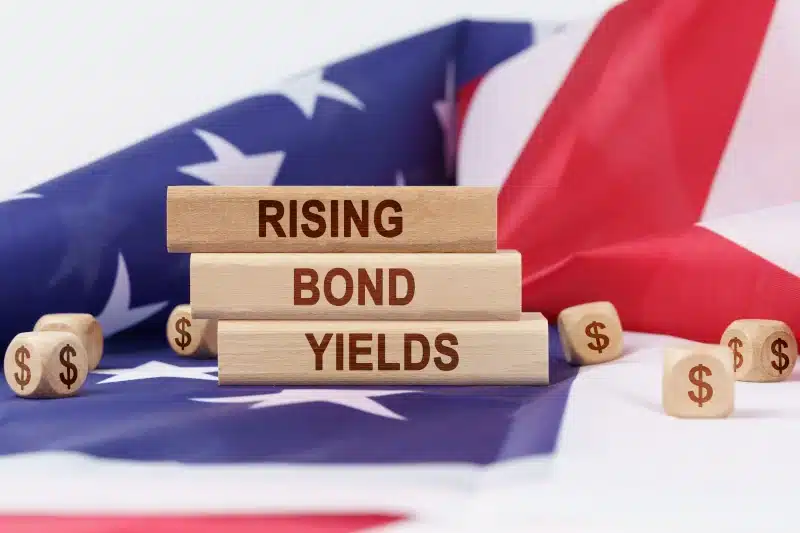
However, in recent months long-term bond yields have been rising, raising the cost to the US government of financing its massive deficits. That prompted the US Treasury to intervene in bond markets by doubling its buybacks of longer-dated bonds.
This is an example of how rising bond yields can actually be bullish for gold too, as the rise in bond yields has come about due to concerns about the US government’s long-term fiscal health. With a growing realization that the US government isn’t going to pay down the national debt, and that the amount of outstanding debt could increase significantly in the coming years, rising bond yields are a sign that markets are going to demand higher interest rates from the government in order to absorb more debt.
Higher interest rates are a sign that the risk of holding US Treasuries is increasing. And if Treasuries are starting to become considered a riskier asset, that could benefit precious metals like gold and silver, which especially if held physically are one of the lowest-risk assets you can choose.
While gold may not yield interest payments, holding physical gold carries zero counterparty risk. Gold in your safe stays the same no matter what happens in financial markets, and no matter which companies or countries go bankrupt.
Falling bond yields significantly lower the opportunity cost of holding non-yielding physical gold.
Volatility in sovereign debt markets can encourage a shift out of paper assets into physical assets like gold.
Escalating national debt loads, rising deficits, and increased interest rate expenses on existing debt raise market concerns regarding the long-term solvency and real returns of US Treasury securities.
Central Bank Gold Purchases
Individuals and financial institutions are not the only buyers of precious metals. Central banks around the world have bought gold in recent years at unprecedented rates.
From China to Russia to smaller countries like Poland and the Czech Republic, central banks are adding gold to their balance sheets for a number of reasons, whether it’s to hedge against financial risk or to diversify away from the dollar. In fact, central banks collectively now hold more gold on their balance sheets than dollars.
Central bankers understand that gold is the ultimate reserve asset due to the fact that it is universally recognized, bought and sold in highly liquid markets, and offers independence from financial markets and sanction risk. As gold continues to play a major role in central bank monetary management, it could signal a shift away from the dollar and paper fiat currencies.
Central banks have purchased thousands of tons of gold in recent years.
Continued accumulation of gold by central banks has influenced gold demand significantly and helped ensure a solid floor for gold prices.
Central bank gold demand underscores the importance of physical gold to international monetary policymakers, who view gold as a key long-term store of value.
How to Help Protect Your Savings with Goldco
The rising price of gold over the past few years is warning us that we’re potentially entering a period of economic turbulence, currency devaluation and financial volatility. Fear of recession is growing in many quarters, stressing out many Americans who are already facing financial difficulties.
If you have spent decades accumulating your retirement savings, leaving your assets vulnerable to the ups and downs of financial markets could be risky. Fortunately there are options for you to diversify your portfolio and help mitigate against the potential for an economic downturn.
Federal tax laws allow you to diversify your retirement savings from existing 401(k), 403(b), TSP, IRA, or similar accounts into physical gold coins and gold bars, with tax-free rollovers. By rolling over assets into a gold IRA, you can harness the safe-haven power of precious metals while maintaining the tax-deferred growth of an IRA account.
Starting a Gold IRA gives you direct ownership of tangible, IRS-approved physical gold coins or gold bars.
Executing a direct rollover from your 401(k), 403(b), TSP, or IRA to a gold IRA allows you to transfer retirement funds tax-free and penalty-free.
Partnering with Goldco connects you with an industry leader that has helped thousands of Americans benefit from owning precious metals, with over $3 billion in precious metals placements and over 8,000 5-star customer reviews.
Working with Goldco to help move your retirement funds into physical gold within a gold IRA can be done in a simple, 3-step process:
Speak with a Goldco precious metals specialist to learn more about how gold IRAs work. If you decide to open a gold IRA, you will then select your gold IRA custodian.
Initiate a rollover request from your existing 401(k) or IRA plan administrator to roll over funds into your gold IRA. Direct rollovers and transfers can be done tax-free.
Select and purchase your IRA-eligible physical gold coins or gold bars, which will be securely shipped and stored in an established bullion depository.
That’s all there is to it. So why wait?
Help Take Control of Your Financial Future Today
Don’t wait for a market downturn or financial crisis to wreak havoc on your decades of hard work and savings. Contact the precious metals specialists at Goldco today to receive your Free Gold & Silver Information Kit and learn how simple it is to help protect your retirement savings with physical precious metals.
This article was originally published in February 2020 and was updated in September 2026.
Precious metals like gold and silver act as safe haven assets against persistent inflation, out-of-control federal spending, and economic volatility Silver demand is driven most heavily by...
Younger generations are increasingly turning to buying gold to help protect their wealth against inflation, currency devaluation, and the underperformance of traditional financial assets Gold...
Key Takeaways Gold prices and government bond yields are rising simultaneously as buyers demand higher compensation for long-term fiscal, duration, and inflation risks rather than economic...
*Applies only to qualified orders. Get up to 5% back in FREE Silver when you purchase $50,000 – $99,999 in Goldco premium coins. Get 10% in FREE Silver when you purchase $100,000 or more in Goldco premium coins. Cannot be combined with any other offer. Additional rules may apply. Contact your representative to find out if your order qualifies. For additional details, please see your customer agreement. Goldco does not offer financial or tax advice regarding the purchase of precious metals.