The Gold-to-Silver Ratio: A Useful Measure or a Misleading Myth?
Written by Peter C. Earle, Ph.D
Share |
5min read
Key Takeaways
The historic 15-to-1 or 16-to-1 gold-to-silver ratios were artificially set by legal tender acts and bimetallic government policies rather than discovering fundamental market equilibria.
Modern gold pricing is primarily driven by monetary safety, inflation hedging, and central bank reserves, whereas silver is heavily influenced by industrial applications (electronics, solar energy) and byproduct mining supply.
The ratio offers real-time insight into macroeconomic sentiment—signaling preference for safety when rising or industrial optimism when falling—but cannot prescribe mean-reverting price targets.
Buyers who assume the ratio must revert to historical averages misapply obsolete 19th-century bimetallic monetary institutions to a modern, floating commodity landscape.
Few numbers in the world have acquired as much mystique as the gold-to-silver ratio. Financial television discusses it, economic historians promote it, and countless buyers watch it for signs that one metal has become “cheap” relative to the other. The idea seems straightforward: if gold has historically traded at, say, 15 or 16 times the price of silver, then a ratio of 90 or 100 must mean silver is dramatically undervalued and destined to outperform It’s an appealing story. Unfortunately, it also oversimplifies a much more complicated history.
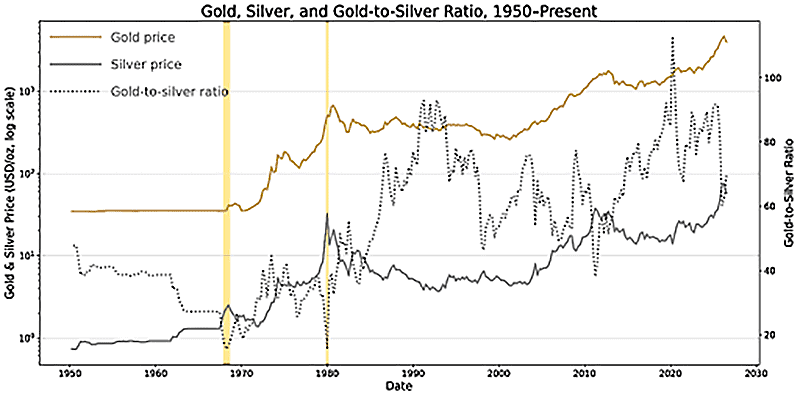
The gold-to-silver ratio simply measures how many ounces of silver it takes to buy one ounce of gold. If gold trades at $3,000 per ounce and silver trades at $30, the ratio is 100-to-1. That number describes current market prices, but many buyers mistakenly assume it also reveals where prices should be. History offers little support for that belief.
The ratio’s importance dates back thousands of years, when both gold and silver served as money. Ancient civilizations, from Egypt to Rome, used both metals for commerce, though not always at the same exchange rate. Governments often attempted to establish official ratios through law, creating systems in which gold and silver coins circulated simultaneously.
One of the best-known examples came with America’s Coinage Act of 1792, which effectively adopted a ratio of roughly 15-to-1 by defining both gold and silver coins as legal tender. Similar policies existed elsewhere. These fixed ratios were not discoveries about nature or economics; they were political choices designed to stabilize a monetary system based on two precious metals (“bimetallic”). Those choices rarely remained stable for long.
Whenever governments fixed the exchange rate between gold and silver at a level that differed from market conditions, one metal became artificially overvalued while the other became undervalued. The undervalued metal disappeared from circulation as people hoarded it or exported it, while the overvalued metal remained in circulation. This is a classic illustration of Gresham’s Law: when two forms of money are legally accepted at a fixed rate, “bad money drives out good.” The problem was not that markets failed. Rather, governments were attempting to freeze prices that markets continually wanted to adjust.
Even Sir Isaac Newton became entangled in this problem while serving as Master of the Royal Mint in the early eighteenth century. In trying to correct England’s coinage, he effectively overvalued gold relative to silver. The unintended consequence was that silver gradually disappeared from circulation, nudging Britain toward what eventually became the gold standard. Few episodes better illustrate how difficult it is to impose a permanent relationship between two commodities whose values are constantly changing.
By the late nineteenth century, the world had largely abandoned bimetallism in favor of gold-based monetary systems. Silver increasingly became associated with industrial applications than as a monetary metal. That transformation fundamentally changed what the gold-to-silver ratio represented.
Today, the forces driving gold and silver prices are often quite different. Gold is purchased primarily as a monetary asset and a store of value, bulwark in times of uncertainty. People buy it during periods of inflation, financial stress, geopolitical tumult, or declining confidence in fiat (paper) money. Central banks collectively hold tens of thousands of metric tons of gold as reserve assets, yet few hold meaningful silver reserves.
Silver, by contrast, occupies two worlds simultaneously. It remains an asset, but it is also an industrial metal used extensively in electronics, solar panels, medical equipment, batteries, and manufacturing processes. Economic growth, technological innovation, and industrial demand therefore influence silver prices in ways that often have little connection to the forces impacting gold.
Mining economics further complicate the picture. Much of the world’s silver is not mined from primary silver deposits but instead produced as a byproduct of mining for copper, zinc, lead, or gold. As a result, silver supply often responds more to conditions in other commodity markets than to silver’s own price. Gold production follows a very different economic logic.
Given these differences, why do so many individuals still believe the ratio must return to some historical average?
Part of the answer is psychology. Humans naturally look for anchors and patterns, especially in financial markets. A ratio that spent long periods near 15 or 16 during the age of bimetallism appears to offer a benchmark against which today’s values can be judged. Yet those historical ratios reflected specific monetary institutions that no longer exist. They were products of coinage laws, legal tender rules, and government policy; they were not not immutable economic laws.
That doesn’t mean, however, that the gold-to-silver ratio is useless. Like many financial indicators, it provides useful descriptive information. A rising ratio often signals people favoring monetary safety over industrial growth. A falling ratio may suggest improving economic optimism or stronger industrial demand for silver. In that sense, the ratio can offer insight into changing market sentiment.
What it cannot do is reveal a “correct” price relationship between the two metals. There is no natural equilibrium requiring gold to trade at 15, 30, 60, or 100 times the price of silver. The appropriate ratio depends on innumerable factors: buyesr preferences, industrial demand, mining output, central bank behavior, technological change, and broader macroeconomic conditions.
The gold-to-silver ratio therefore occupies an unusual place in financial history. It remains an interesting statistic with deep historical roots and some degree of genuine informational value. But it is best understood as a snapshot of current market conditions rather than a compass pointing toward some inevitable destination. Ratios are descriptive, not prescriptive. They tell us what buyers are willing to exchange one asset for today; not what they ought to exchange tomorrow. Like the price-to-earnings ratio, the yield curve, or the VIX, the gold-to-silver ratio is one useful indicator among many. Treating it as an iron law of markets risks confusing centuries of fascinating monetary history with a rule that no longer governs the modern world.
About the author: Peter C. Earle, Ph.D, is the Director of Economics and Economic Freedom and is Head of Research who joined AIER in 2018. He holds a Ph.D in Economics from l’Universite d’Angers, an MA in Applied Economics from American University, an MBA (Finance), and a BS in Engineering from the United States Military Academy at West Point.
Prior to joining AIER, Dr. Earle spent over 20 years as a trader and analyst at a number of securities firms and hedge funds in the New York metropolitan area as well as engaging in extensive consulting within the cryptocurrency and gaming sectors. His research focuses on financial markets, monetary policy, macroeconomic forecasting, and problems in economic measurement. He has been quoted by the Wall Street Journal, the Financial Times, Barron’s, Bloomberg, Reuters, CNBC, Grant’s Interest Rate Observer, NPR, and in numerous other media outlets and publications.
Disclaimer: All opinions expressed by the author are the author’s opinions and do not reflect the opinions of Goldco. The author’s opinions are based on the author’s personal experience, education and information the author considers reliable. Goldco does not warrant that the information contained herein is complete or accurate, and it should not be relied upon as such.
Precious metals like gold and silver act as safe haven assets against persistent inflation, out-of-control federal spending, and economic volatility Silver demand is driven most heavily by...
Younger generations are increasingly turning to buying gold to help protect their wealth against inflation, currency devaluation, and the underperformance of traditional financial assets Gold...
Key Takeaways Gold prices and government bond yields are rising simultaneously as buyers demand higher compensation for long-term fiscal, duration, and inflation risks rather than economic...
*Applies only to qualified orders. Get up to 5% back in FREE Silver when you purchase $50,000 – $99,999 in Goldco premium coins. Get 10% in FREE Silver when you purchase $100,000 or more in Goldco premium coins. Cannot be combined with any other offer. Additional rules may apply. Contact your representative to find out if your order qualifies. For additional details, please see your customer agreement. Goldco does not offer financial or tax advice regarding the purchase of precious metals.



 About the author: