The U.S. national debt breached $40 trillion, adding roughly $6.5 billion in debt per day over a 22-week span with little political reaction.
In response to surging long-term Treasury yields, the Treasury doubled its maximum “liquidity support” buyback operations in long-dated securities to artificially support bond prices and temper interest rates.
Debt buybacks do not reduce the overall national debt or lower spending; they merely shift debt across different maturity dates, swapping long-term duration risk for short-term refinancing risk.
Gold surged above $4,500/oz as buyers recognized a compounding debt-and-interest feedback loop.
The US national debt crossed $40 trillion this week, a milestone that would once have inspired alarm, debate, or at least a few uncomfortable questions in Washington. Instead, it arrived almost as a routine statistical update. The federal government’s outstanding debt stood at $40.047 trillion on August 18, only 154 days after crossing $39 trillion. Over those 22 weeks, Washington added roughly $6.5 billion in debt per day. The reaction from the political establishment was muted. The reaction from the gold market was not.
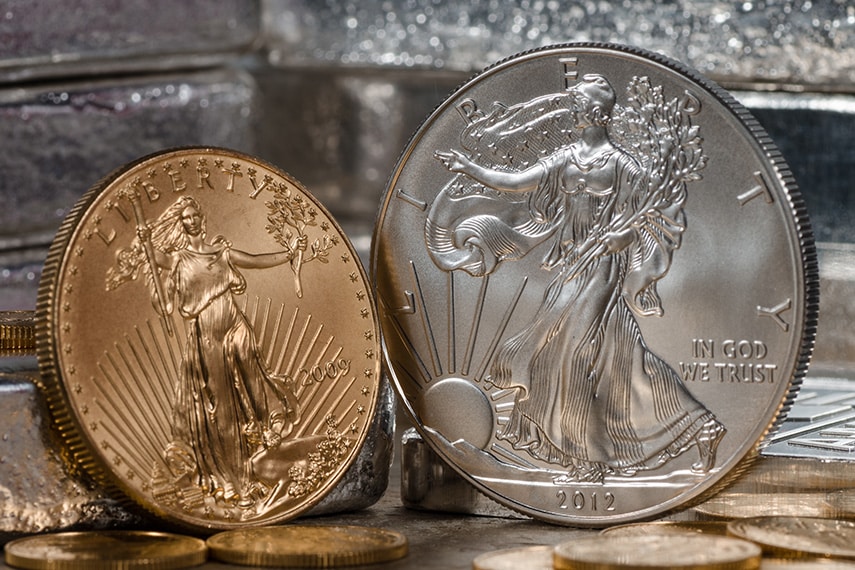
Gold surged back above $4,500 per ounce following the Treasury Department’s announcement that it would dramatically expand purchases of long-dated government bonds. It was the metal’s first move above that level in two months. Silver joined the rally, rising above $68 per ounce. The juxtaposition was striking: just as the national debt passed another historic threshold, the Treasury announced that it would double the maximum size of its “liquidity support” buybacks in the parts of the bond market facing the greatest pressure.
Treasury Intervenes to Cool Surging Bond Yields
Beginning September 9, Treasury will increase the maximum size of individual buyback operations involving 10- to 20-year and 20- to 30-year securities from $2 billion to at least $4 billion. The expanded program will remain in place through November 4, when Treasury will provide additional guidance.
Officials described the change as an effort to support liquidity in longer-dated securities, pointing to the volume of high-quality offers received in previous operations. Technically, that description is accurate. Economically, however, the timing makes the announcement difficult to dismiss as an innocuous adjustment to market plumbing.
Long-term Treasury yields had been surging. The 30-year yield reached 5.34 percent intraday on August 18, its highest level since 2007, before closing at 5.31 percent. After the announcement, it fell to 5.19 percent. Treasury had succeeded, at least temporarily, in doing what additional demand normally does: raising bond prices and lowering yields. The decline was short-lived, however, with the 30-year yield returning to approximately 5.24 percent Thursday morning.
The Difference Between Buybacks and Real Fiscal Relief
These buybacks are not quantitative easing. The Federal Reserve is not creating reserves to purchase Treasury securities, and Treasury is not permanently extinguishing the government’s financing obligation. It will purchase older, less-liquid long-term securities and finance those purchases through additional issuance elsewhere, likely including shorter maturities. In essence, the government will borrow money to retire existing debt while continuing to issue new debt. That can improve liquidity and reduce market dislocations, but it cannot reduce the underlying volume of federal borrowing.
The distinction matters, but so does the signal. The bond market is demanding greater compensation for holding US government obligations over several decades. Persistent deficits, stubborn inflation risks, immense prospective issuance, and doubts about fiscal discipline are being incorporated into long-term yields.
Treasury’s response is to become a larger buyer in precisely the sectors where those concerns are being expressed most forcefully. At only a few billion dollars per operation in a Treasury market exceeding $30 trillion, the program is small. Its informational content is much larger.
Why Gold Responded to Treasury Intervention
Gold’s rally reflects that informational content. The metal does not merely react mechanically to movements in interest rates. Ordinarily, falling yields are favorable because they reduce the opportunity cost of holding a non-yielding asset. But gold also responds to the institutional reasons that yields are falling. A decline caused by improving inflation expectations is one thing. A decline encouraged by official intervention because the government finds market-clearing borrowing costs increasingly uncomfortable is something else entirely.
The fiscal background makes the latter interpretation plausible. Through the first ten months of fiscal 2026, federal interest expense reached $1.17 trillion, up 15.5 percent from the same period a year earlier.
The government incurred approximately $1.2 trillion in interest costs during fiscal 2025. With debt now exceeding $40 trillion, even modestly higher average funding costs rapidly compound the budget problem. More interest requires more borrowing, which increases the supply of debt, which may still require higher yields to attract buyers. That feedback loop is precisely what gold investors are watching.
Conclusion
Treasury buybacks may temporarily smooth trading, concentrate issuance in more liquid securities, and shave a few basis points from financing costs. But no buyback program can produce another taxpayer, eliminate another federal spending commitment, or summon another willing long-term creditor. Nor can shifting issuance toward shorter maturities make the risk disappear. It merely replaces duration risk with refinancing risk, leaving taxpayers more exposed if short-term rates remain elevated or rise again.
Crossing $40 trillion does not mean an immediate fiscal crisis is inevitable, and a $4 billion buyback operation does not amount to full-scale yield-curve control. Yet markets trade on trajectories as well as present conditions.
Gold’s move above $4,500 suggests that buyers recognize the direction of travel: more debt, greater interest expense, mounting pressure on the bond market, and an increasingly strong official incentive to restrain borrowing costs. Washington may regard $40 trillion as just another milestone. Gold is treating it as evidence.
About the author: Peter C. Earle, Ph.D, is the Director of Economics and Economic Freedom and is Head of Research who joined AIER in 2018. He holds a Ph.D in Economics from l’Universite d’Angers, an MA in Applied Economics from American University, an MBA (Finance), and a BS in Engineering from the United States Military Academy at West Point.
Prior to joining AIER, Dr. Earle spent over 20 years as a trader and analyst at a number of securities firms and hedge funds in the New York metropolitan area as well as engaging in extensive consulting within the cryptocurrency and gaming sectors. His research focuses on financial markets, monetary policy, macroeconomic forecasting, and problems in economic measurement. He has been quoted by the Wall Street Journal, the Financial Times, Barron’s, Bloomberg, Reuters, CNBC, Grant’s Interest Rate Observer, NPR, and in numerous other media outlets and publications.
Disclaimer: All opinions expressed by the author are the author’s opinions and do not reflect the opinions of Goldco. The author’s opinions are based on the author’s personal experience, education and information the author considers reliable. Goldco does not warrant that the information contained herein is complete or accurate, and it should not be relied upon as such.
Concerns over inflation and a potential market downturn are causing many Americans to question the safety of their retirement savings More and more Americans are considering buying gold, which...
While conventional 401(k) plans rarely offer direct physical metal options, savers can legally acquire physical gold by rolling over eligible 401(k) assets into a self-directed gold IRA...
Precious metals like gold and silver act as safe haven assets against persistent inflation, out-of-control federal spending, and economic volatility Silver demand is driven most heavily by...
*Applies only to qualified orders. Get up to 5% back in FREE Silver when you purchase $50,000 – $99,999 in Goldco premium coins. Get 10% in FREE Silver when you purchase $100,000 or more in Goldco premium coins. Cannot be combined with any other offer. Additional rules may apply. Contact your representative to find out if your order qualifies. For additional details, please see your customer agreement. Goldco does not offer financial or tax advice regarding the purchase of precious metals.




 About the author: