
Key takeaways:
- A 2026 survey sponsored by Goldco and conducted by Money.com found that 66.1% of respondents are more focused on protecting wealth than they were a few years ago.
- The cost of living (69.5%) and inflation (67.6%) are the top factors shaping how the retirement savers surveyed manage their money today.
- Gold remains a relatively small holding today, but 12.1% of respondents say they plan to use it in the future. It’s the only asset tested where planned future use exceeds current use.
As retirement approaches, financial risks that once seemed like routine parts of saving and investing can start to feel more tangible — and increasingly urgent.
A market downturn can cut deeply into decades of savings, and with fewer working years left to recover, the loss can leave a lasting mark. Rising prices for groceries, gas and other everyday necessities, meanwhile, loom especially large when savings will soon take the place of a regular paycheck.
Against that backdrop, many retirement savers are rethinking how they manage their money.
In a September 2026 survey from Goldco and Money.com of 1,400 U.S. adults age 45 and older with retirement savings, about two-thirds (66.1%) say they’re more focused on protecting existing wealth than they were a few years ago. Roughly one-third (33.9%) say their focus is unchanged, lower or they’re unsure.
That doesn’t mean retirement savers have abandoned growth. About 43% describe their overall approach as a balance of protecting their money and seeking growth, while another 18% say they focus mainly on long-term or aggressive growth.
For many, that means keeping enough money within reach to feel financially secure while still investing for the future and spreading risk across different assets. And, for a sizable share, gold is becoming part of the conversation.
Rising prices weigh heaviest
Two pressures stand out in how retirement savers are managing their money today.
Survey respondents cite the cost of living (69.5%) and inflation (67.6%) as the issues weighing most heavily on their decisions, ahead of high interest rates (31.0%), uncertainty about retirement income (30.7%) and stock market volatility (28.4%).
Those pressures also shape how respondents define financial security: More than half (55.6%) say it means having enough savings to cover emergencies, while 50.4% point to not worrying about monthly bills or day-to-day expenses.
Respondents’ portfolios also reflect a preference for liquidity.
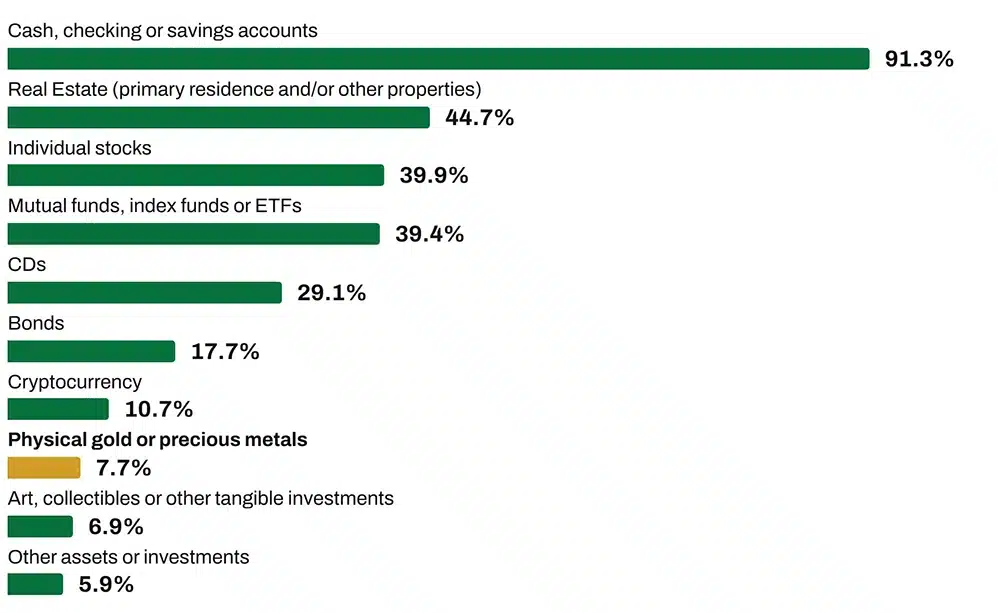
Cash is the most common holding for the retirement savers surveyed: 91.3% of respondents hold cash, checking or savings accounts, followed by 44.7% who hold real estate, 39.9% individual stocks and 39.4% mutual funds, index funds or ETFs.
Share who currently own or hold each type of asset or investment
(respondents could select mroe than one)
Twenty-eight percent say they’re keeping more of their money in cash, savings or cash-like accounts than they were a few years ago, while 14.1% say they’re keeping a smaller share.
That doesn’t mean growth has fallen off the radar. Among respondents who say they’re “somewhat more focused” on protecting wealth than they were a few years ago, 49.5% still describe their approach as a balance of protection and growth. Even among those who are “much more focused” on protection, 42.3% say the same.
Diversification also matters to retirement savers. Among respondents who consider their portfolios “very diversified,” 42.5% say they’re very confident their strategy will provide financial security in retirement. That falls to 15.1% among those who consider themselves “somewhat diversified” and to roughly 6% among those who describe their portfolios as poorly diversified.
What retirement savers are considering next
The search for balance extends beyond the assets retirement savers already own.
When respondents were asked what they plan to use as part of their long-term financial strategy, no single option dominated.
Planned use is highest for real estate (20.1%), followed by bonds (17.4%), insurance products such as annuities or life insurance (16.4%), CDs (15.7%) and gold or precious metals (12.1%).
Physical gold and precious metals remain relatively uncommon holdings today: 7.7% of respondents say they currently own them.
But a separate question about long-term financial strategy points to greater consideration going forward. In that question, 12.1% say they plan to use gold in the future, compared with 7.1% who currently do. Gold is the only category tested where planned future use exceeds current use.
Gold also has the highest “not sure” rate of any asset tested: 19.8% of respondents say they aren’t sure whether they’ll use it in the future. That leaves a meaningful group still weighing the idea rather than ruling it out.
The appeal is largely rooted in wealth preservation. Stability during economic uncertainty (51.1%) and long-term value preservation (50.3%) are the two most commonly cited reasons gold appeals to respondents. Diversification, tangible ownership and inflation protection are close behind, at roughly 46% each.
Still, for many respondents, interest in gold is tempered by questions about what owning it actually involves.
The biggest hesitations, according to the survey, are the costs and fees associated with buying or selling gold (47.9%), lack of familiarity or knowledge (46.4%) and storage or safety issues (44.7%). Respondents also cite value fluctuations (42.1%), liquidity (39.3%) and regulatory or tax considerations (25.9%). Another 11.7% say they have none of these concerns.
Those concerns often overlap — respondents selected an average of 2.6 apiece — and may also reflect a broader unfamiliarity with how gold investing works. Nearly 4 in 10 respondents cited liquidity, for example, which could mean they’re unsure how quickly physical gold can be converted into cash.
Questions about costs and fees may also reflect a knowledge gap. Gold can come with transaction costs and, depending on how it’s held, storage or custodial fees. But investors encounter expenses across other asset classes, too. Real estate, which more respondents own, comes with agent commissions, closing costs, property taxes and upkeep. Mutual funds charge annual expense ratios, and some annuities carry hefty ongoing costs and surrender charges.
Conclusion: There’s more than one way to play it safe
Retirement savers are changing how they protect their nest egg. Cash is taking on a bigger role, but respondents aren’t putting all their faith in one “safe” asset.
Many still want growth and diversification, and are actively considering a wider mix of assets for the years ahead. For a notable share, gold is becoming a key part of the conversation.
Methodology
This study was sponsored by Goldco and conducted by Money.com.
Money.com surveyed 1,400 U.S. adults age 45 and older with retirement savings about wealth protection, growth, diversification and investment preferences.
Respondents were employed full time, self-employed or retired. Qualifying respondents needed to hold at least one type of retirement account or plan (such as a 401(k), 403(b), IRA, SEP/SIMPLE IRA, pension, annuity, or other retirement savings vehicle). Those with no retirement account were excluded. Respondents were also screened on trading behavior, and those who personally bought or sold investments weekly or more often were excluded. Quotas were applied across age, employment status and retirement account types. Analysis was conducted at the 95% confidence level.
