Only a few short years ago, the United States experienced the highest inflation rates in over 40 years as inflation rates peaked at over 9%. That was a wake up call for many Americans who had been pacified by decades of low inflation rates.
While inflation rates have since fallen, they’re still higher than they were a decade ago, and the rise in prices over the past several years has hit many Americans in their pocketbooks. Going to the grocery store, buying goods on Amazon, or purchasing a car have become painful experiences for millions of Americans.
In fact, the rising cost of living has become a more and more important political topic, and could end up becoming a major factor in the 2026 midterm elections. But as with many other economic topics, there’s a lot of misinformation out there when it comes to inflation.
If inflation is becoming an increasing problem in your life, here are three things about inflation that you need to know.
1. Prices Won’t Be Coming Down
The biggest impact of inflation is felt when people go to the store and experience sticker shock. Something that was $4.99 last week all of a sudden is $5.99. Or in the case of shrinkflation, that 16-ounce package of roast beef for $5.29 is now a 14-ounce package for the same price.
The question many people have when they see these price increases is, when will prices come down? And the unfortunate answer is that they won’t.
Sure, you may see decreases in price on certain food items, for instance, whose prices have risen due to seasonal issues, disease in animal flocks, or other factors, once those impacts disappear. But the general trend of prices is always up.
When prices rise because of an increase in the money supply, generally the only way for them to start coming down is when the money supply decreases. But that almost never happens.
If you remember your MV=PQ equation of exchange from Intro Macroeconomics, you remember that when M increases, so does P, ceteris paribus. But if a decrease in V is enough to offset the increase in M, prices could decrease too.
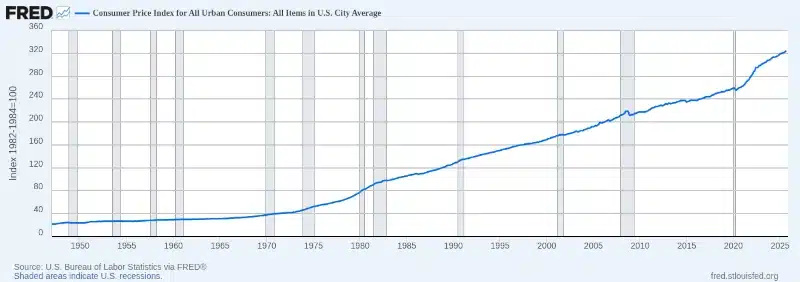
In the US, inflation rates are measured in the Consumer Price Index (CPI). With available data going back to 1947, the only times that CPI has fallen measurably were during the 2008 recession and during the 2020 recession.
Even during previous recessions prices continued to increase. And as you can see from the CPI charts, the trend is for inflation to continue rising, which means that the price level won’t fall back to where it was.
That’s because…
2. Inflation Is a Monetary Phenomenon
As Milton Friedman infamously stated, inflation is always and everywhere a monetary phenomenon. And the effect of an increase in the money supply, all other things being equal, is an increase in the general price level.
The modern economics profession has a tendency to get causation backward, and so the original classical economic definition of inflation – an increase in the money supply, the effect of which is an increase in the price level – has been replaced by defining inflation as an increase in the price level.
That’s why you might hear people talk about the inflationary aspects of tariffs, as tariffs will cause the prices of tariffed goods to rise. If you subscribe to the definition of inflation as a rise in prices, then yes, you would view tariffs as inflationary.
But if you subscribe to the traditional definition of inflation, you’ll understand that inflation is caused by an increase in the money supply, and that prices that rise due to non-monetary factors aren’t due to inflation.
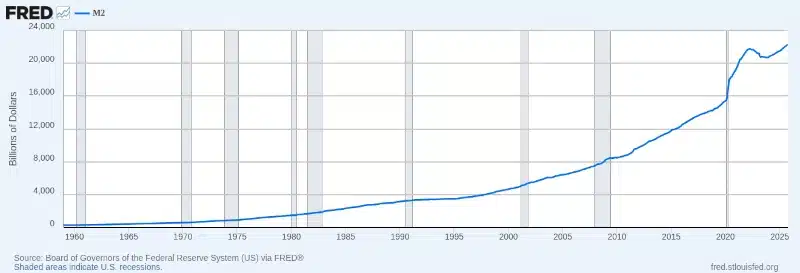
Let’s look at the money supply in the US.
As you can see, there was an enormous increase in the money supply in 2020 in response to the COVID lockdowns. This was the result of the financial stimulus that the federal government provided in the form of free checks to American households.
That sharp increase in the money supply caused prices to rise, which was reflected in CPI rising to the highest level in over 40 years. That was followed by an unusual decrease in the money supply, the only time since 1959 that that has happened, and then by another increase so that the money supply is now higher than it was when inflation peaked in 2022.
The reason the money supply doesn’t normally fall is because the Federal Reserve is deathly afraid of deflation. In its conventional history of the Great Depression, the Fed maintains that the Great Depression was exacerbated by deflationary monetary policy, and this deflation is what made the Great Depression so bad.
That’s why the Fed resorts to inflationary measures such as quantitative easing in response to recessions and financial crises. As Ben Bernanke stated in response to criticism that the Federal Reserve’s deflation exacerbated the Great Depression, “You’re right, we did it. We’re very sorry. We won’t do it again.”
3. You Don’t Have to Fall Victim to Inflation
When you go to the store and see how much prices have risen, you may take a fatalistic view and think that there’s nothing you can do about it. You’re a price taker, not a price maker, and you have to accept the prices that stores charge, or you do without.
But that doesn’t mean that you have to allow yourself to be victimized by inflation. Just because the dollar is being devalued by inflation doesn’t mean that your dollars have to sit idly by and lose their value.
If you understand that inflation is eating away at the value of your savings, and you take proactive steps to help protect those savings, you could help mitigate the negative impact inflation might have on your hard-earned wealth.
Help Protect Yourself From Inflation With Gold and Silver
One step that many people have taken to help protect themselves against the negative impacts of inflation is buying precious metals like gold and silver. Precious metals have a long history of acting as hedges against inflation.
Both gold and silver tend to increase in value over time, unlike the US dollar. Whereas the dollar has lost 88% of its purchasing power since 1971, silver has risen over 4,000% in value, while gold has risen over 11,000% since then.
Gold and silver also have a history of performing well during periods of inflation. During the 1970s stagflation, for instance, gold and silver prices both grew at annualized rates of over 30% per year over the course of the decade.
And today, with economic uncertainty rising and inflation remaining problematic, gold and silver prices are once again rising, setting all-time highs. Is it time for you to put those rising prices to work in helping safeguard your portfolio?
Buy Gold and Silver From Goldco
Goldco has helped thousands of Americans benefit from adding gold and silver to their portfolios. And our over 8,000 5-star reviews are a testament to the quality of both our gold and silver products and our customer service.
At Goldco we have worked hard to make ourselves one of the best gold companies in the country. And we’re so confident that you’ll be happy with your purchase that we even offer one of the best buy back programs in the industry.*
Why sit back and let inflation continue taking a bite out of your hard-earned savings? Call Goldco today and start putting gold and silver to work for you in helping protect your financial well-being against inflation.
*Please talk with your Goldco representative for details of the Goldco Buy Back program.
Key Takeaways Increased geopolitical conflict and oil prices surging toward $120 per barrel have pushed up US recession probabilities Persistent energy shocks threaten to reverse progress on...
Rising debt levels and delinquency rates are reaching levels not seen in years, signaling worsening household financial stability The US national debt has reached nearly $39 trillion, creating...
Only a few short years ago, the United States experienced the highest inflation rates in over 40 years as inflation rates peaked at over 9% That was a wake up call for many Americans who had been...
*Applies only to qualified orders. Get up to 5% back in FREE Gold or Silver when you purchase $50,000 – $99,999 in Goldco premium coins. Get 10% in FREE Gold or Silver when you purchase $100,000 or more in Goldco premium coins. Cannot be combined with any other offer. Additional rules may apply. Contact your representative to find out if your order qualifies. For additional details, please see your customer agreement. Goldco does not offer financial or tax advice regarding the purchase of precious metals.